U.S. state issues guidance against amalgam

For the first time ever, a U.S. state has warned against the use of amalgam! On 25 August 2025, Florida’s Department of Health issued guidance warning against amalgam:
 
“State Surgeon General Dr. Joseph A. Ladapo recommends against the use of dental amalgam for routine fillings due to the risk of mercury exposure…  Amalgam releases low levels of mercury in the form of a vapor, which can be inhaled and absorbed by the lungs and other organs, and has been found to cause DNA damage in human blood cells and potential impairment with renal function.”

Continue reading

World Alliance for Mercury-Free Dentistry salutes Brazil’s Ministries of Health, Foreign Affairs, and Environment

The World Alliance for Mercury-Free Dentistry salutes the federal government of Brazil both for accelerating its pace toward ending the use of dental amalgam, and for international leadership to amend the Minamata Convention on Mercury.

“We appreciate the important officials of the Health Ministry who took time to meet with us on 21 July to discuss the transition on Brazil to mercury-free dentistry, both for SUS* and in new government policies,” said Charlie Brown, president of the World Alliance for Mercury-Free Dentistry.  Officials participated from four sections of the ministry:  environmental health, oral health, occupational health, and international.

Itamaraty** has been at the forefront of having an effective international treaty addressing mercury-free dentistry,” Brown added.  “Both during the negotiations of the basic treaty in 2012, and in the adoption of the Children’s Amendment in 2022, the government of Brazil stepped forward to play an essential and constructive role.” 

Continue reading

Experts concerned that children of color and low-income children still receive unsafe mercury fillings

Experts continue to express concern that many children of color and low-income children are still receiving mercury fillings despite the risks.  In their Health Affairs article “Children of Color and Low-Income Kids Still Receive Unsafe Mercury-Based Dental Fillings”, Dr. Rueben C. Warren, DDS, MPH, DrPH, MDiv of Tuskegee University and Dr. Mark Mitchell,MD, MPH, FACPM of George Mason University observe that…

“The data on the extent of amalgam use in the US are sparse and out of date, but in our experience as dental and medical professionals, we’ve seen that Black, Latino, Native American, and low-income kids are much more likely to get mercury-based amalgam fillings than their more affluent non-Hispanic White counterparts.”

Continue reading

Another major manufacturer exits the amalgam business

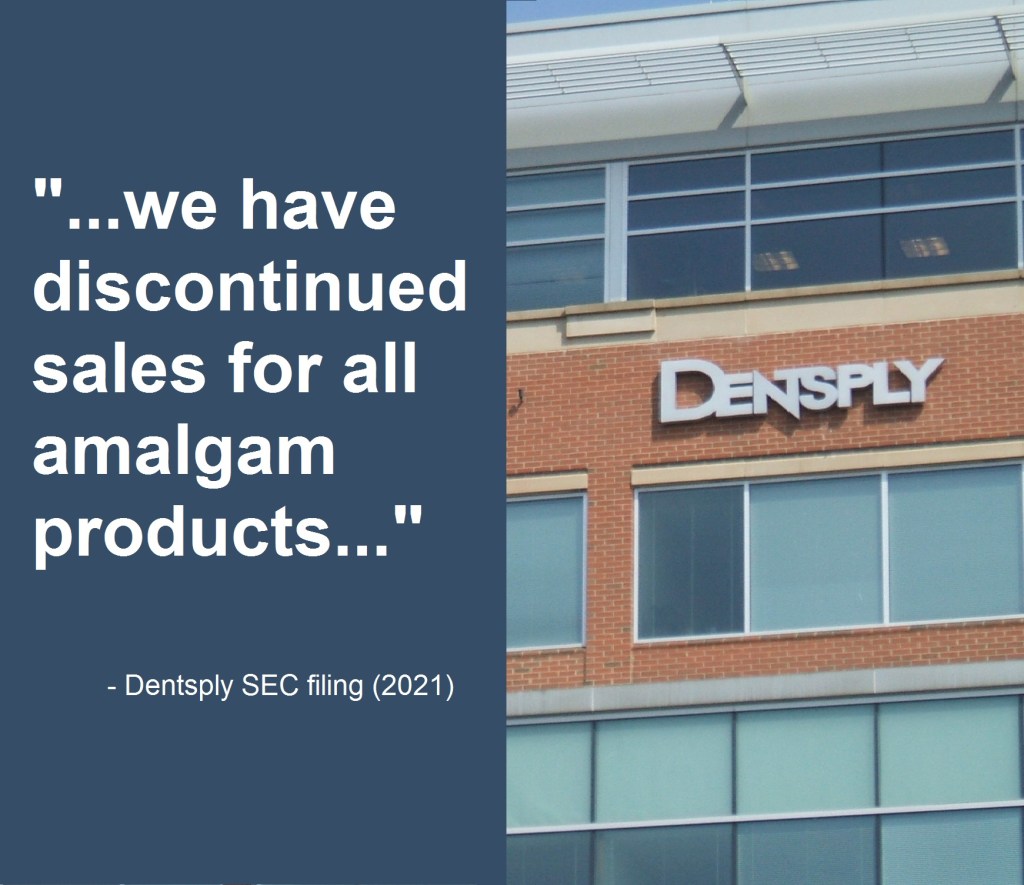
Dentsply Sirona quietly stopped its amalgam sales, as announced last year.  Now the other major U.S. amalgam manufacturer, Kerr (currently a subsidiary of Envista Holdings Corporation and previously a subsidiary of Danaher), has announced that it has “…ceased manufacturing all Alloy products, including all of our amalgam products that may contain mercury.” Kerr goes on to explain that….
 
“Specifically, we ceased manufacturing these products in the third quarter of 2021 and communicated this decision to our customers in November of 2021. As part of this communication, we cancelled many of our customers outstanding orders for amalgams containing mercury and directed our customers to our other materials that do not contain mercury. We also engaged in a vigorous campaign to assist our customers in swapping their amalgam products containing mercury to materials that do not contain mercury.”
 

Continue reading

Leading dental products manufacturer stops selling amalgam 

In the clearest sign yet that amalgam is headed to the dustbins of history, Dentsply Sirona – the world’s largest manufacturer of dental products – has exited the amalgam market.  In its annual report to the U.S. Securities and Exchange Commission, this industry behemoth quietly noted: “[W]e have discontinued sales for all amalgam products as of December 2020.”


The coup de grâce for Dentsply appears to have been U.S. Food and Drug Administration’s recommendation against amalgam use in high-risk populations.  As Dentsply explained:

Continue reading